GIA vs. IGI vs. SGL: Which Certification Should You Trust?
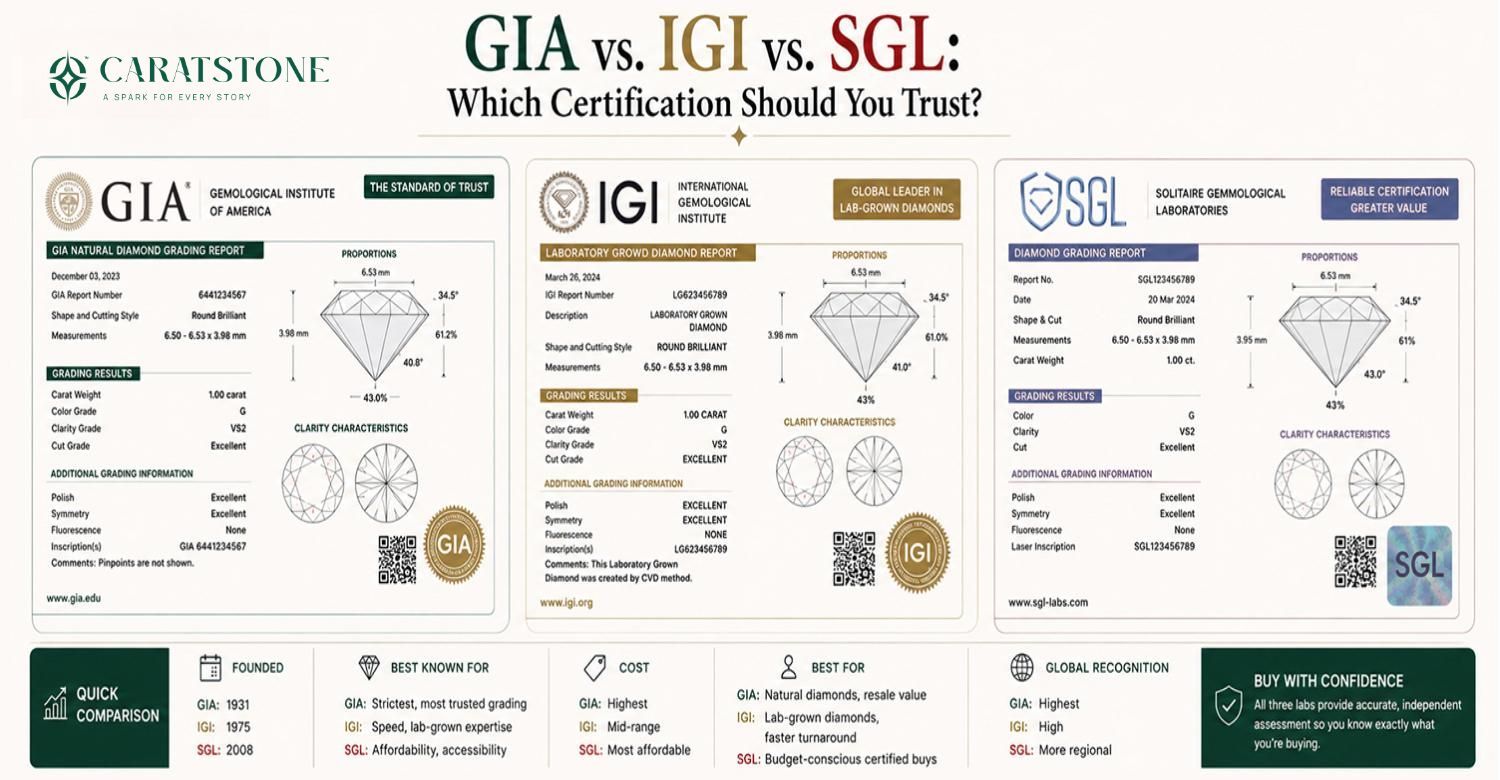
This guide explains the key differences between GIA, IGI, and SGL diamond certifications, including grading standards, cost, trust, resale value, and suitability for natural or lab-grown diamonds. It also helps buyers understand which certification best matches their priorities, from maximum resale confidence to affordable, reliable certification through CaratStone Jewels.
If you've started shopping for a diamond, you've probably noticed the same three letters showing up again and again: GIA, IGI, and SGL. They all sound official, but they're not the same, and the differences actually matter for what you're paying and what you're getting.
Here's a plain-language breakdown of each one, so you know exactly what's behind the certificate before you buy.
The Overview
GIA is the most rigorous and globally trusted certification, and it's the standard other labs are measured against. IGI is highly reliable and especially strong for lab-grown diamonds, with a large international network. SGL offers accurate, affordable grading and works well for buyers who want solid certification without the GIA premium. None of the three will sell you a fake, but they don't grade with identical strictness, and that difference can shift a diamond's real value.
What a Certification Actually Tells You
A diamond certificate isn't a price tag. It's an independent report that evaluates the stone against the 4Cs- cut, color, clarity, and carat weight- along with measurements and, often, a diagram of any inclusions. It exists so you're not relying on a seller's word for what you're buying.
What most first-time buyers don't realize is that two diamonds with nearly identical certificates from two different labs can actually differ by a full grade or more in real terms. The lab issuing the report matters just as much as the report itself.
GIA: The Standard Everyone Else Is Measured Against
The Gemological Institute of America, founded in 1931, is a non-profit lab based in Carlsbad, California, and it's the organization that created the 4Cs grading system used industry-wide today. That history is a big part of why GIA reports carry the most weight with jewelers, appraisers, and resale buyers.
GIA's grading is known for being conservative, meaning it tends to grade a little stricter than other labs rather than more generously. That strictness is exactly why it's trusted: a GIA-graded VS1 diamond is reliably a VS1, without room for interpretation.
The trade-off is cost. GIA certification typically runs higher than IGI or SGL, which gets passed along in the diamond's price. For a natural diamond, especially anything you might consider an investment piece, that premium is usually worth paying.
IGI: Strong, Fast, and the Leader for Lab-Grown Diamonds
The International Gemological Institute operates a much larger global network than GIA, with major labs in Antwerp, Mumbai, and New York. That scale means faster turnaround times, which is a real advantage if you're not willing to wait weeks for a certificate.
IGI has become the go-to certification body for lab-grown diamonds, and its grading standards for lab-grown stones are well regarded across the industry. If you're buying lab-grown, an IGI report is a strong, dependable choice, not a compromise.
The one caveat worth knowing: because IGI operates so many labs worldwide, grading can vary slightly from location to location. It's not a reason to avoid IGI, but it's worth checking that the specific report matches the physical stone closely, which is good practice with any certification, not just IGI's.
SGL: Reliable and Budget-Friendly
The Solitaire Gemmological Laboratories, with labs across India, the UK, and the Middle East, is generally the most affordable of the three. It's a legitimate, accurate grading body, just with a broader range of grading outcomes and less global brand recognition than GIA or IGI.
SGL works well for buyers who want genuine third-party certification without paying a premium for the certificate itself, particularly for smaller stones or lab-grown diamonds where the cost difference matters more relative to the total price.
Quick Comparison
Does the Certification Affect Resale Value?
Yes, and this is worth knowing before you buy, not after. A GIA-certified diamond generally holds resale value better than an equivalent stone certified by IGI or SGL, simply because GIA's grading is the most conservative and universally trusted. If resale or future appraisal matters to your decision, that's a real factor.
If you're keeping the piece rather than planning to resell it, this matters much less. All three labs will accurately verify what you're buying, just with different degrees of strictness behind the grade on the paper.
How to Choose?
If you're buying a natural diamond, particularly a larger or higher-value stone, GIA certification is worth the premium for the trust and resale value it carries. If you're buying lab-grown, IGI is a genuinely excellent choice, not a lesser one, and reflects the industry standard for lab-grown grading. If your priority is a certified, accurate stone at the most accessible price point, SGL is a legitimate option worth considering.
At CaratStone Jewels, every diamond, natural or lab-grown, ships with certification from GIA, IGI, SGL, or USGL, so you can choose the stone and setting you want with the report that matches your priorities, whether that's maximum resale confidence or the best value for your budget.
Frequently Asked Questions
1. Is an IGI certified diamond less valuable than a GIA certified one?
Not necessarily less valuable, but IGI grading tends to be slightly less conservative than GIA's, which can affect resale value more than everyday quality. For lab-grown diamonds specifically, IGI is considered a strong, industry-standard choice.
2. Can two diamonds with the same grade from different labs actually look different?
Yes. Because grading standards vary slightly between labs, a diamond graded VS1 by one lab could be closer to VS2 by another lab's stricter standard, even though both reports use the same terminology.
3. Is SGL certification trustworthy?
Yes, SGL is a legitimate, accurate certification body. It's simply less globally recognized than GIA or IGI, which makes it a strong budget-friendly option rather than a red flag.
4. Should I always choose GIA no matter what?
Not always. GIA is the strongest choice for natural diamonds and resale-focused purchases, but IGI is often the better fit for lab-grown diamonds specifically, since it's the industry leader in that category.
5. Does CaratStone Jewels use all three certifications?
Yes. CaratStone works with GIA, IGI, SGL, and USGL, so you can choose based on what matters most to you, whether that's maximum trust and resale value or the most accessible price for verified quality.
Conclusion
Choosing between GIA, IGI, and SGL ultimately depends on what matters most to you. GIA offers the strongest global recognition and is especially suited to natural diamonds and resale-focused purchases. IGI is an excellent choice for lab-grown diamonds, while SGL provides reliable certification at an accessible price. Whatever you choose, a trusted certification helps you buy with confidence, knowing your diamond’s quality has been independently evaluated.